
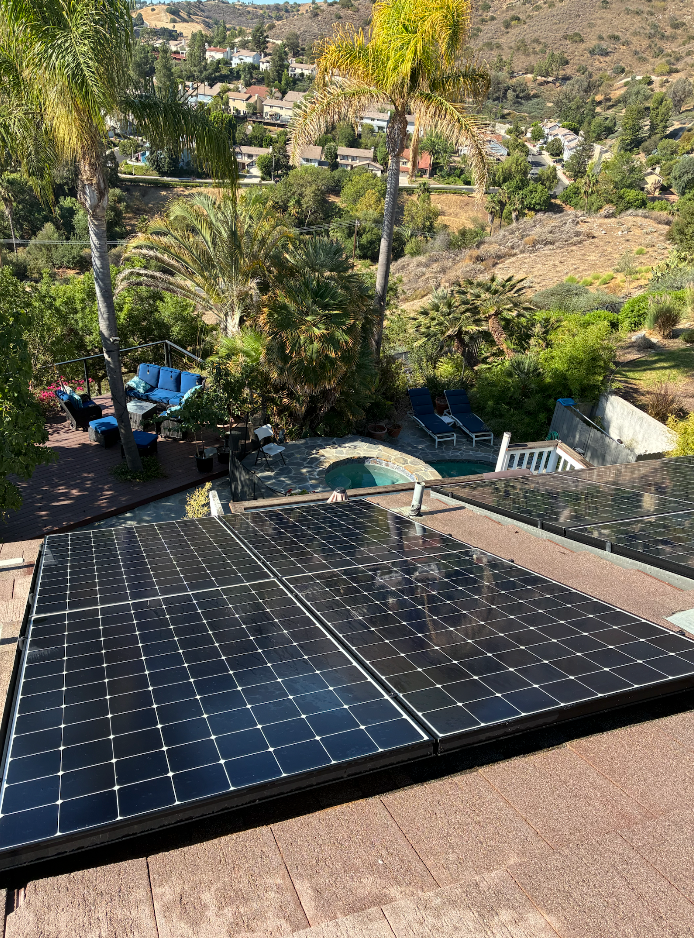
Solar Panel Cleaning in Ventura County
Solar panel cleaning is the removal of dust, pollen, salt film, wildfire ash, and bird droppings from a photovoltaic array using deionized water and soft brushes, with no detergents and no high pressure. Ventura County Roof Cleaning provides solar panel cleaning across Ventura County, CA, including Oxnard, Moorpark, Camarillo, Simi Valley, Thousand Oaks, Ventura, Newbury Park, and Agoura Hills. A typical residential array of 20 to 30 panels is cleaned in 1 to 2 hours, and cleaning generally recovers 5 to 30% of the output lost to soiling, depending on how long the array has gone without rain or service.
The part most homeowners get wrong is which kind of dirt matters. A film of dry dust across the whole array costs a few percent. A single opaque bird dropping in the wrong place can take a third of a panel offline. Those are different problems with different urgency, and the reason is how panels are wired, not how dirty they look.
Key Takeaways
- Uniform dust is a small, gradual loss. Point soiling such as bird droppings or a leaf is a large, sudden one, because a shaded cell limits the whole substring it sits in.
- Ventura County’s marine layer is not a free rinse. Drizzle below roughly 5 mm mobilizes dust and dries it in place, which leaves panels dirtier than before it fell.
- Flat and low tilt arrays, common on Oxnard Plain and Camarillo commercial roofs, get almost no benefit from rain and soil fastest.
- Local tap water is hard, so rinsing with it replaces dust with mineral spotting. We finish with deionized water.
- We do not publish a price. Panel count, roof pitch, access, and soiling severity all move it, so every job is quoted after a free on-site estimate.
Why One Bird Dropping Costs More Than a Season of Dust
The cells inside a solar panel are wired in series, so current through the string is limited by the weakest cell in it, the same way a single narrow section limits flow through a pipe. A standard 60 cell panel is built as three substrings of 20 cells, each protected by a bypass diode.
When one cell is heavily shaded by an opaque deposit, it stops producing and begins to resist the current the other cells are pushing through it. The bypass diode then switches on to route current around that substring, which protects the panel from damage and takes roughly one third of that panel’s output offline at the same time. So the loss from one dropping is not proportional to the area it covers. It is a step change.
There is a safety dimension as well. A shaded cell that is not bypassed dissipates the surrounding cells’ energy as heat, which is the hot spot failure mode that panel certification testing under IEC 61215 is specifically designed to screen for. Hard deposits left in place for a full dry season are the field version of that test.
| Soiling type | How it behaves electrically | Practical urgency |
|---|---|---|
| Even dust and pollen film | Small proportional loss across every cell | Scheduled service |
| Salt haze on coastal glass | Proportional loss, plus it holds moisture and dust | Scheduled service |
| Wildfire ash | Proportional at first, then cements as it absorbs moisture | Clean before the first rain |
| Bird dropping or leaf mat | Opaque point shading, triggers a bypass diode | Prompt, disproportionate loss |
| Lichen or growth at the frame edge | Creeping point shading plus drainage blockage | Prompt, and it recurs |
Why the Marine Layer Makes Ventura County Panels Dirtier, Not Cleaner
Ventura County has a Mediterranean climate with a dry season that commonly runs May through October, and the coastal plain around Oxnard averages roughly 15 inches of rain a year (NOAA 1991 to 2020 climate normals). That already means five or six months of uninterrupted deposition. The marine layer then makes it worse rather than better.
Soiling researchers, including at the National Renewable Energy Laboratory (NREL), generally treat a rain event of about 5 mm, or roughly 0.2 inches, as the minimum needed to meaningfully reset an array. Below that threshold the water does not sheet off with enough volume to carry particles away. It wets the dust, draws it into a slurry, and then evaporates and leaves it cemented to the glass as a bonded film. Overnight marine layer drizzle and morning fog drip sit almost entirely below that threshold.
This is why the intuition that “it rained last week, the panels are fine” fails here specifically. A homeowner in Ventura, Oxnard, or Port Hueneme can get moisture on the glass most mornings for months and end the dry season with a harder deposit than a homeowner in a drier inland tract who got nothing at all.
Panel Tilt Decides How Much Work the Rain Does For You
Even when real rain arrives, how much of it helps depends on the angle the array sits at. Water needs enough slope to sheet and carry particles over the lower frame rail. Below roughly 5 degrees it pools, evaporates, and leaves a tide line at the frame instead.
Google published results from its Mountain View, California campus showing that cleaning flat mounted panels that had run 15 months without service roughly doubled their output, while its tilted rooftop panels benefited far less because rain had already been doing the work. Same climate, same year, opposite conclusions, and the only variable was tilt.
| Array geometry | Where it is common locally | How much rain helps |
|---|---|---|
| Steep pitch, 20 degrees or more | Hillside tracts in Thousand Oaks, Agoura Hills, Simi Valley | Rain does real work between services |
| Moderate pitch, 10 to 20 degrees | Most Ventura County tract housing | Partial, uneven along the lower rail |
| Low tilt, 5 to 10 degrees | Newer low slope residential, some Camarillo builds | Little, and residue collects at the bottom edge |
| Flat or near flat, under 5 degrees | Oxnard Plain and Camarillo commercial and warehouse roofs | Effectively none, water pools and dries in place |
Ventura County is also one of California’s leading agricultural counties, and the flat roofs closest to working ground on the Oxnard Plain combine the highest dust load with the geometry that sheds it worst. Those two facts compound.
Why We Rinse With Deionized Water
Local supply is hard water. Calleguas Municipal Water District serves much of the county at roughly 200 to 300 mg/L hardness as calcium carbonate. Rinse a panel with it and the water evaporates off hot glass within minutes, leaving dissolved calcium behind as a mineral spot ring on the exact surface the panel needs to be optically clear.
That is a genuine own goal: the array is no longer dusty, it is scaled, and scale does not rinse off the way dust does. Deionized water has had those minerals stripped out, so it dries without residue and needs no squeegee pass on a surface that should not be scrubbed. It is also why we do not use detergents, which leave a film that then attracts the next round of dust, and why we do not use pressure, which can drive water past the panel’s edge seal and damage the anti reflective coating that manufacturers’ warranties depend on.
We also work panels cool, early in the day. Cold water hitting glass that has been baking in Ventura County summer sun is a thermal shock risk, and a hot panel flashes water off so fast that even good water spots.
Solar Panel Cleaning Near Me: Every Ventura County City We Serve
If you are searching for solar panel cleaning near me in Ventura County, Ventura County Roof Cleaning covers the whole county and the easternmost Los Angeles County communities. Conditions differ enough across those areas that the right service interval does too.
| Area | Cities and communities | Dominant soiling driver |
|---|---|---|
| Coastal plain | Oxnard, Port Hueneme, Ventura, Silver Strand | Salt film plus marine layer drizzle that cements dust |
| Central county | Camarillo, Somis, Moorpark | Agricultural dust and low tilt commercial arrays |
| Conejo Valley | Thousand Oaks, Newbury Park, Westlake Village, Agoura Hills | Oak and sycamore litter, pollen, point shading from leaf mats |
| Simi and Santa Susana | Simi Valley, Moorpark, Santa Susana Knolls | Santa Ana wind dust and grit, wildfire ash |
| Heritage Valley and inland | Santa Paula, Fillmore, Piru, Ojai | Citrus and row crop dust, longest gaps between real rain |
We also serve solar panel cleaning in Calabasas and Woodland Hills, which are in Los Angeles County rather than Ventura County but sit inside our service radius.
Our Solar Panel Cleaning Process
- Inspect and set up. We identify panel type, tilt, roof access, and any visible microcracking, seal wear, or frame growth before touching the array.
- Dry debris removal. Leaf mats, twigs, and nesting material come off first, along with anything trapped between the panel and the roof deck.
- Soft wash the glass. Soft bristle brushes and low pressure only. No abrasives, no detergents, no scrubbing of the anti reflective coating.
- Deionized rinse. A spot free final rinse so nothing is left on the glass as the array dries.
- Final walk and report. We confirm coverage, flag anything we saw that is a solar installer’s job rather than ours, and clear the surrounding roof and gutters of what came off.
What Solar Panel Cleaning Will Not Fix
Being straight about the limits is part of the estimate. Cleaning restores output lost to soiling. It does not address:
- Panel degradation. Photovoltaic cells lose a fraction of a percent of output per year permanently. No cleaning recovers that.
- Microcracks, delamination, or yellowed encapsulant. These are physical failures. We flag them and you take them to your installer or the panel warranty.
- Inverter, optimizer, or wiring faults. If output dropped suddenly and the glass is clean, the problem is electrical and we will tell you so rather than sell you a wash.
- Permanent shading. A tree or a chimney casting a shadow is a design problem, not a cleaning problem.
- Roof problems under the array. We are a cleaning company, not a roofer. Leaks and structural issues get referred out.
What Determines Your Solar Panel Cleaning Cost
We quote every system after a free on-site estimate rather than publishing a figure, because the same panel count can be a routine job or a difficult one. What moves it:
- Number of panels and total array area
- Roof pitch, height, and how the array is accessed safely
- Tilt, since low tilt arrays hold heavier and more bonded soiling
- How long since the last cleaning, and whether ash or droppings have cemented
- Residential rooftop versus a commercial or ground mounted installation
- Whether you are combining it with roof, gutter, or window service in the same visit
For how often to schedule service, what soiling actually costs in kilowatt hours, and whether cleaning pays for itself, see our full guide to solar panel cleaning in Ventura County.
Frequently Asked Questions
Is there solar panel cleaning near me in Ventura County?
Yes. Ventura County Roof Cleaning provides solar panel cleaning across Ventura County, CA, including Oxnard, Moorpark, Camarillo, Simi Valley, Ventura, Thousand Oaks, Newbury Park, Santa Paula, and Ojai, plus Calabasas and Woodland Hills in Los Angeles County. Call (805) 908-2005 or request a free on-site estimate.
Does cleaning solar panels really increase output?
Yes. Cleaning generally recovers 5 to 30% of the output lost to soiling, with the largest gains on arrays that have gone a full dry season without rain or service. Flat mounted panels see the biggest jump because rain does almost nothing for them.
Why does one bird dropping matter so much?
Because cells are wired in series. One opaque deposit stops its cell producing and limits current for its whole substring until a bypass diode routes around it, which typically takes about a third of that panel offline. The loss is far larger than the area covered.
Can I just clean my solar panels with a garden hose?
It is a poor trade. Local supply water runs roughly 200 to 300 mg/L hardness, so it dries into mineral spotting on the glass, and hosing a hot panel adds thermal shock risk. Household detergents leave a film that attracts more dust, and ladder falls are a leading cause of non-fatal home injury (CDC).
Will cleaning void my solar panel warranty?
Not when it is done to manufacturer guidance, which is what our method is built around: no abrasives, no detergents, no high pressure. Warranty problems come from pressure washing, scrubbing the anti reflective coating, or forcing water past the edge seal.
Do you clean solar panels on tile roofs?
Yes. Tile requires staging off the array and walking the roof correctly so tiles are not cracked underfoot, which is the same discipline our tile roof cleaning crews already work to.
Do you clean commercial and ground mounted solar?
Yes. Flat roof commercial arrays across the Oxnard Plain and Camarillo are among the highest value systems to clean on a schedule, precisely because their geometry means rain never resets them.
Related Services
Pair solar panel cleaning with soft wash roof cleaning to remove the algae and moss feeding debris onto the array, gutter cleaning to clear what comes off the roof, or window cleaning for the full exterior in one visit. We provide solar panel cleaning across the county, including Ventura, Oxnard, Moorpark, Camarillo, Simi Valley, and Thousand Oaks.
Ready to recover your lost output? Request a free solar panel cleaning estimate or call (805) 908-2005.